
How to Measure Your Existing Stairs for Retrofit Stair Treads
Posted by Josh Lorg on October 13, 2026
Replacing worn, outdated, or carpet-covered stairs can completely change the look of a staircase. But before ordering retrofit stair treads, accurate measurements are essential. Even a small measurement mistake can create installation problems, gaps, or an uneven finished appearance.
Learning how to measure existing stairs for retrofit stair treads is straightforward when you know which dimensions matter. You will need to measure the width, depth, riser height, and existing nosing on each step. Taking a few extra minutes to measure carefully can help ensure your new stair treads fit properly and create a professional-looking finished staircase.
What Measurements Do You Need for Retrofit Stair Treads?
Most staircase projects require several key measurements. Do not assume every stair is exactly the same, particularly in older homes.
|
Measurement |
What to Measure |
Why It Matters |
|
Stair width |
Side to side across the tread |
Determines tread length |
|
Tread depth |
Front edge to back of tread |
Determines required tread depth |
|
Riser height |
Top of one tread to the next |
Helps evaluate overall stair dimensions |
|
Existing nosing |
Projection beyond the riser |
Important for determining the retrofit fit |
|
Number of steps |
Count all treads |
Determines total material needed |
For the most accurate results, measure each individual step rather than measuring only the top and bottom stairs.
How to Measure Existing Stairs for Retrofit Stair Treads
1. Measure the Stair Width
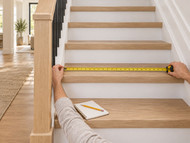
Start by measuring the width of each existing stair tread from one side to the other.
Place your tape measure across the tread and record the measurement at several points if the staircase appears uneven. Older stairs can vary slightly from one step to another.
For example, if one step measures 36 inches while another measures 36 1/4 inches, record the differences rather than assuming the entire staircase is identical.
When ordering or preparing retrofit stair treads, use the actual dimensions of the staircase and account for any installation requirements or trimming that may be necessary.
2. Measure the Existing Tread Depth
Next, measure the tread from the front edge toward the riser.
If the existing stair has a projecting nosing, measure the usable tread surface and note how far the nosing extends beyond the riser.
This measurement is particularly important when replacing existing treads with retrofit stair treads because the new tread needs to properly cover the existing surface.
Write down both the overall depth and the nosing projection when applicable.
3. Measure the Riser Height
Measure vertically from the top surface of one tread to the top surface of the next tread.
Although riser height does not determine the tread size by itself, it provides important information about the staircase and can help identify inconsistencies.
Measure several risers throughout the staircase. If the measurements vary significantly, investigate the existing construction before beginning a retrofit stair tread installation.
4. Check the Existing Nosing
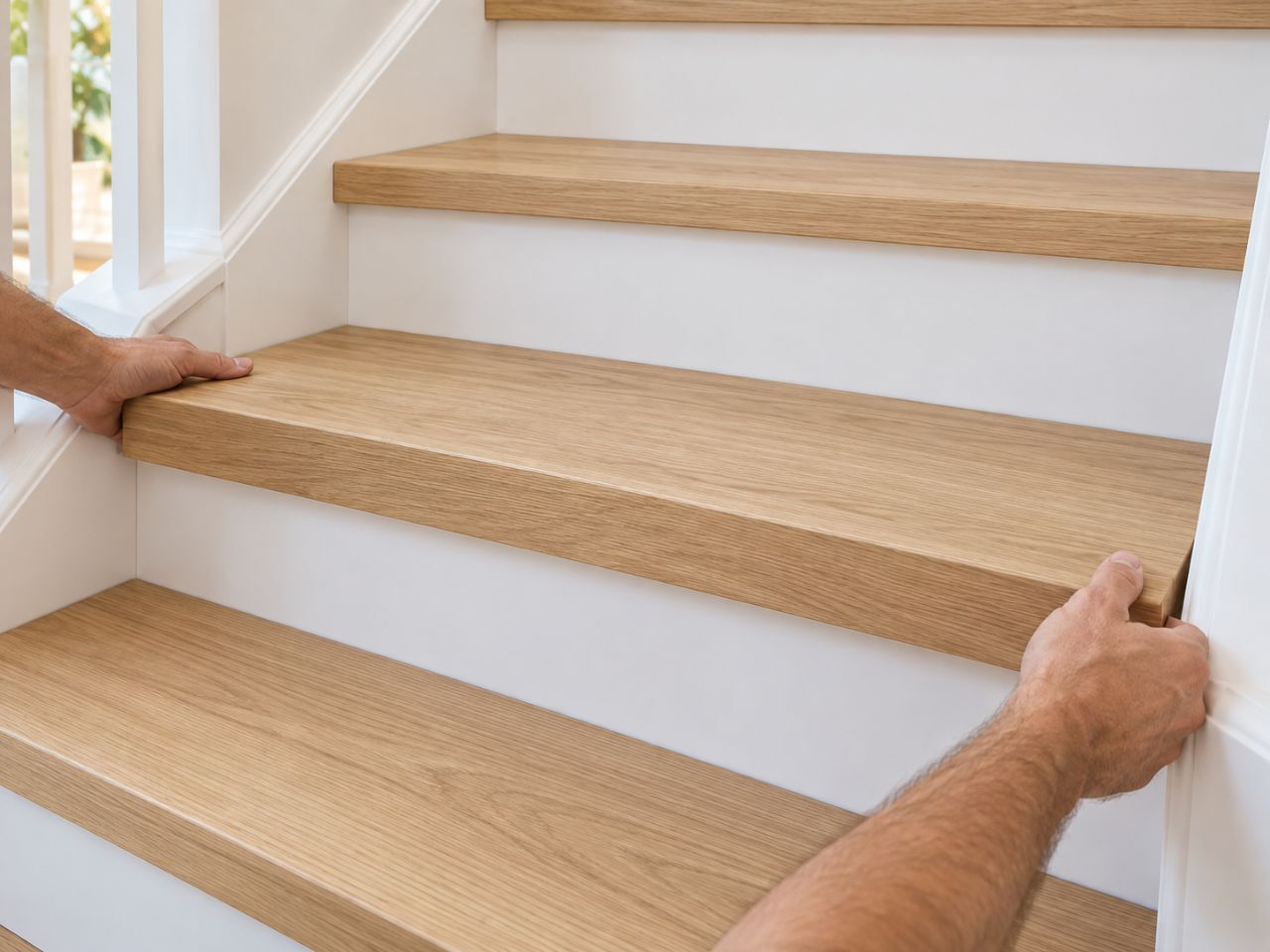
The front edge of a stair tread, commonly called the nosing, deserves special attention.
Measure how far the existing nosing projects beyond the riser. Also inspect its shape and condition.
Take note of:
- Nosing projection
- Nosing thickness
- Rounded or square edges
- Damaged or worn areas
- Carpet or other flooring that must be removed
A retrofit tread is designed to install over an existing stair surface, so understanding the current nosing configuration is critical before selecting the appropriate tread.
Measure Every Stair, Not Just One
One of the most common measuring mistakes is assuming that all stairs in a staircase are identical.
While many staircases are built with consistent dimensions, existing stairs can develop variations because of construction tolerances, remodeling, settling, or previous flooring installations.
For the best results, create a simple measurement sheet and record each step individually.
For example:
|
Step |
Width |
Depth |
Riser Height |
Nosing |
|
1 |
36" |
10 1/2" |
7 1/2" |
1" |
|
2 |
36" |
10 1/2" |
7 1/2" |
1" |
|
3 |
36 1/8" |
10 3/4" |
7 1/2" |
1" |
This simple approach makes it much easier to identify variations before ordering materials.
What Tools Do You Need?
You do not need specialized equipment to measure most existing staircases.
Have these tools available:
- Tape measure
- Pencil
- Notepad or measurement worksheet
- Straightedge or level
- Calculator
- Camera or smartphone for reference photos
A straightedge can be particularly useful when checking whether existing treads are level or whether the front edge is straight.
Check the Condition of the Existing Stairs
Measurements are only part of the preparation process. Retrofit stair treads need a suitable surface underneath them.
Before installation, inspect each existing step for:
- Loose boards
- Squeaking or movement
- Rot or water damage
- Uneven surfaces
- Protruding nails or screws
- Adhesive or flooring remnants
- Carpet padding or other materials
Any structural or surface problems should be addressed before installing new treads.
If carpet is being replaced, remove the carpet, padding, staples, and other materials that could interfere with the new tread sitting securely and evenly.
Account for Your Finished Staircase
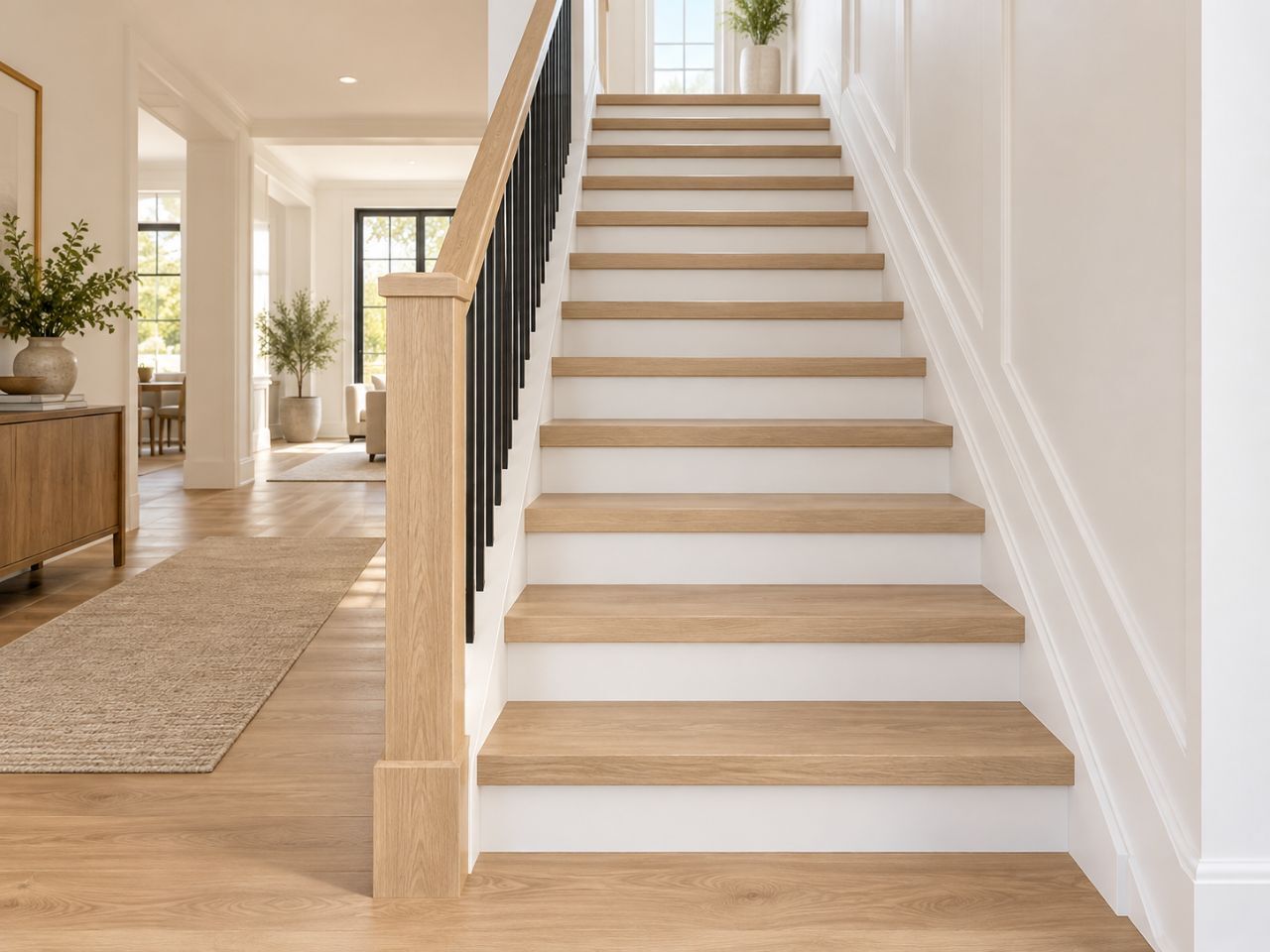
When measuring for replacement stair treads, think about the finished dimensions rather than simply covering the existing stairs.
The thickness of the new tread can affect the relationship between the tread and riser. This is especially important when installing wood retrofit stair treads over existing steps.
Before ordering, confirm the product's dimensions, installation requirements, and whether trimming or additional preparation will be needed for your specific staircase.
For larger remodels or stairs with significant dimensional variations, working with an experienced contractor or stair professional can help prevent costly mistakes.
Tips for Getting Accurate Stair Measurements
Keep these tips in mind when measuring:
- Measure twice. Recheck every important dimension before ordering.
- Measure every step. Do not assume an older staircase is perfectly uniform.
- Record measurements immediately. A written chart prevents confusion later.
- Measure the nosing carefully. Its projection can affect retrofit tread fit.
- Inspect underneath existing flooring. Carpet and padding can hide important dimensions.
- Check for uneven surfaces. A new tread will not correct a structural problem.
- Take photos. Pictures can help document unusual corners, walls, or stair conditions.
- Confirm product specifications. Make sure the retrofit tread dimensions and installation method match your project.
Make Measuring the First Step of Your Stair Upgrade
Accurate measurements are the foundation of a successful stair renovation. By carefully recording the stair tread width, depth, riser height, and nosing dimensions, you can make better decisions when selecting retrofit stair treads and preparing your existing staircase.
If you are wondering how to measure existing stairs for retrofit stair treads, the process comes down to careful measuring, documenting every step, and evaluating the condition of the existing staircase. Take your time, double-check your numbers, and make sure the existing surface is ready before installation begins.
With the right measurements and preparation, retrofit stair treads can provide a practical way to transform an existing staircase with a clean, finished wood appearance.
Looking to add retrofit stair treads to your home or new build? Contact us today to get started!